
How Warrants Work in Ionia County
A warrant starts with a judge or a magistrate. In Ionia County, that authority is shared. The 64-A District Court can appoint magistrates who set bail, accept bond, and issue arrest and search warrants. The 8th Circuit Court handles felony matters and can act on warrants tied to circuit cases. The Friend of the Court office asks a circuit judge for bench warrants when a support order is broken. Each of these paths ends with a signed order, and each one lands in a different place.
An active warrant is one that has been signed but not yet cleared. It stays open until the person is arrested, posts bond, or the court cancels it. A bench warrant is a subtype that a judge issues from the bench, usually because someone missed a hearing or ignored an order. Because Ionia County spreads this work across offices, there is no single screen that lists every open warrant. The reason behind the warrant tells you which door to knock on.
That split is normal for a smaller Michigan county. It also means a warrant search here is really a set of phone calls and record requests, not a name typed into one database.
Types of Ionia County Warrants
Warrants are not all the same. The type controls who issued it, why it exists, and how a person clears it. Some come from a criminal case. Others come from a missed court date or an unpaid support order. A few, like a felony nonsupport warrant, involve the state Attorney General rather than a local judge. The list below breaks down the warrant types seen in Ionia County.
- Arrest warrant - lets officers take a named person into custody for a suspected crime.
- Bench warrant - issued by a judge when someone misses a hearing or disobeys a court order.
- Search warrant - authorizes police to search a place or seize property tied to a case.
- Friend of the Court child support warrant - a bench warrant used to enforce a support order when payment stops.
- Attorney General felony nonsupport warrant - a state-level warrant that can follow long-term nonpayment of support.
Search warrants work differently from the rest. They target a place or an item, not a person, so they rarely surface in a public name search. Arrest and bench warrants follow the individual until the matter is resolved.
How to Check for an Ionia County Warrant
Because no public roster exists, an Ionia County warrant search runs through a fallback chain. You start with the office tied to the reason for the warrant, then move outward to the sheriff records desk and the county records process. Each channel answers a slightly different question. The table below maps the main options, how to use each one, and where to reach it.
| Channel | How to Use It | Contact |
|---|---|---|
| Friend of the Court | Ask about a child support bench warrant and how to resolve it. | 877-543-2660 |
| 64-A District Court | For criminal and traffic warrants; magistrates set bail and accept bond. | Bonds 9:00 AM to 5:00 PM at the court |
| Sheriff Records Desk | Request a public record or confirm warrant-related information. | (616) 527-5737 |
| County FOIA Process | Use when the information is not indexed anywhere else. | ioniacounty.org/foia |
| Jail / Inmate Info | Check custody status after someone has been arrested. | (616) 527-5390 |
Order matters. If the warrant involves unpaid child support, start with Friend of the Court, since that office controls the file. If it involves a crime or a missed traffic date, the district court and the sheriff are the right first calls. The sheriff records division also lists an America's Most Wanted link on its forms and resources page, which can help when a fugitive matter is public.
Note: A phone call to the office that issued a warrant is often faster and more reliable than any online search, since Ionia County keeps no combined public warrant list.
Ionia County Warrant Contacts
Three offices carry most of the county's warrant traffic. Friend of the Court owns support enforcement. The sheriff records desk handles public-record requests and confirmations. The jail line answers custody questions once a person is booked. Full contact details make each call or visit easier to plan.
Friend of the Court
100 W. Main St.
Ionia, MI 48846
877-543-2660
clarkS32@michigan.gov
Sheriff Records Desk
133 Adams Street
Ionia, MI 48846
(616) 527-5737
Public-record requests and confirmation
Jail / Inmate Info
Ionia County Correctional Center
133 E. Adams St., Ionia, MI 48846
(616) 527-5390
Custody status after an arrest
Use the jail line only when someone has already been taken into custody. It confirms whether a person is being held, which the warrant offices cannot always tell you in real time.
What an Ionia County Warrant Record Shows
When a warrant record is released or confirmed, it carries a predictable set of details. These are the fields an office reads back or prints when it responds to a request. Some fields stay hidden while a case is open, and a search warrant reveals far less than an arrest warrant. The table below outlines what a typical Ionia County warrant record can contain.
| Field | What It Shows |
|---|---|
| Person Named | The subject the warrant authorizes officers to arrest. |
| Warrant Type | Whether it is an arrest, bench, or search warrant. |
| Issuing Court | The district or circuit court that signed the order. |
| Underlying Charge or Order | The offense or the court order that was violated. |
| Bond or Bail Amount | The sum set for release, when one is listed. |
| Status | Whether the warrant is active or has been cleared. |
A confirmed criminal or traffic warrant often ties back to a case you can look up. Once charges are filed, the matter shows on the county's criminal court records, where the charge, bond, and hearing dates live in one file.
What to Do If You Have an Ionia County Warrant
An open warrant does not go away on its own. It can lead to arrest at a traffic stop, at work, or at home. The safer path is to deal with it on your own terms. The right steps depend on the type of warrant, but the sequence below fits most Ionia County cases and keeps you from walking in blind.
- Confirm the warrant exists by calling the office tied to the matter.
- Talk to a lawyer before you take any action.
- For a child support warrant, contact Friend of the Court to arrange payment or a hearing.
- For a criminal or traffic warrant, plan to post bond at the district court or, after 5:00 PM, at the sheriff office.
- Appear at the scheduled arraignment or hearing and follow the court's instructions.
Important: Speak with a lawyer before you turn yourself in, since counsel can arrange a surrender, argue bond, and protect your rights at arraignment.
Friend of the Court Warrants in Ionia County
Child support enforcement is the clearest warrant path in the county. Friend of the Court treats a bench warrant as a last resort, used only after other remedies fail to bring a payer before the court. The goal is payment, not punishment. A person with an active support warrant is asked to contact the office by phone, email, or in person to work out the file.
The consequences build if the warrant is ignored. A payer who is arrested and cannot post the original bond is lodged in the county jail, interviewed by Friend of the Court, and, when the matter is unresolved, arraigned before a circuit judge. Bond money is often applied to past-due support. Continued nonpayment can push the case further, as the steps below show.
- The court may suspend a driver license for ongoing nonpayment.
- The Attorney General can pursue a felony nonsupport warrant.
- Posted bond can be redirected toward the support arrears owed.
Details on this process live on the FOC bench warrant page. Anyone who thinks a support warrant may be open should call before an arrest forces the issue.
Posting Bond and Custody in Ionia County
Warrants and bond are closely linked in Ionia County. A magistrate at the district court can set the bail amount and accept the payment that releases a person. District court bonds are accepted at the 64-A District Court between 9:00 AM and 5:00 PM, and after 5:00 PM they move to the sheriff office. That after-hours handoff is why a late arrest still has a clear bond path.
Custody is a separate question from the warrant itself. Once officers act on a warrant, the person is booked into the county jail, and the jail line becomes the place to confirm that status. The full booking picture, including who is held and on what, sits with the county's jail and inmate records. Bond rules and payment options appear on the county bond information page.
Note: Bond amounts and acceptance hours can change, so confirm the current figure and cutoff time with the court or the sheriff before you travel to post a bond.
Access Limits on Ionia County Warrant Records
Not every warrant is open to the public. A warrant tied to an active investigation can stay confidential until officers act on it, because early disclosure would defeat its purpose. Sealed warrants, juvenile matters, and federal warrants also sit outside the county's public channels. When a record does not surface, treat it as unavailable rather than proof that none exists.
The legal line for county records runs through the Michigan Freedom of Information Act. The county publishes its request steps on the Ionia County FOIA page, which accepts requests by mail, fax, email, or hand delivery. The act also lists categories that a public body may withhold, and law-enforcement material is one of them.
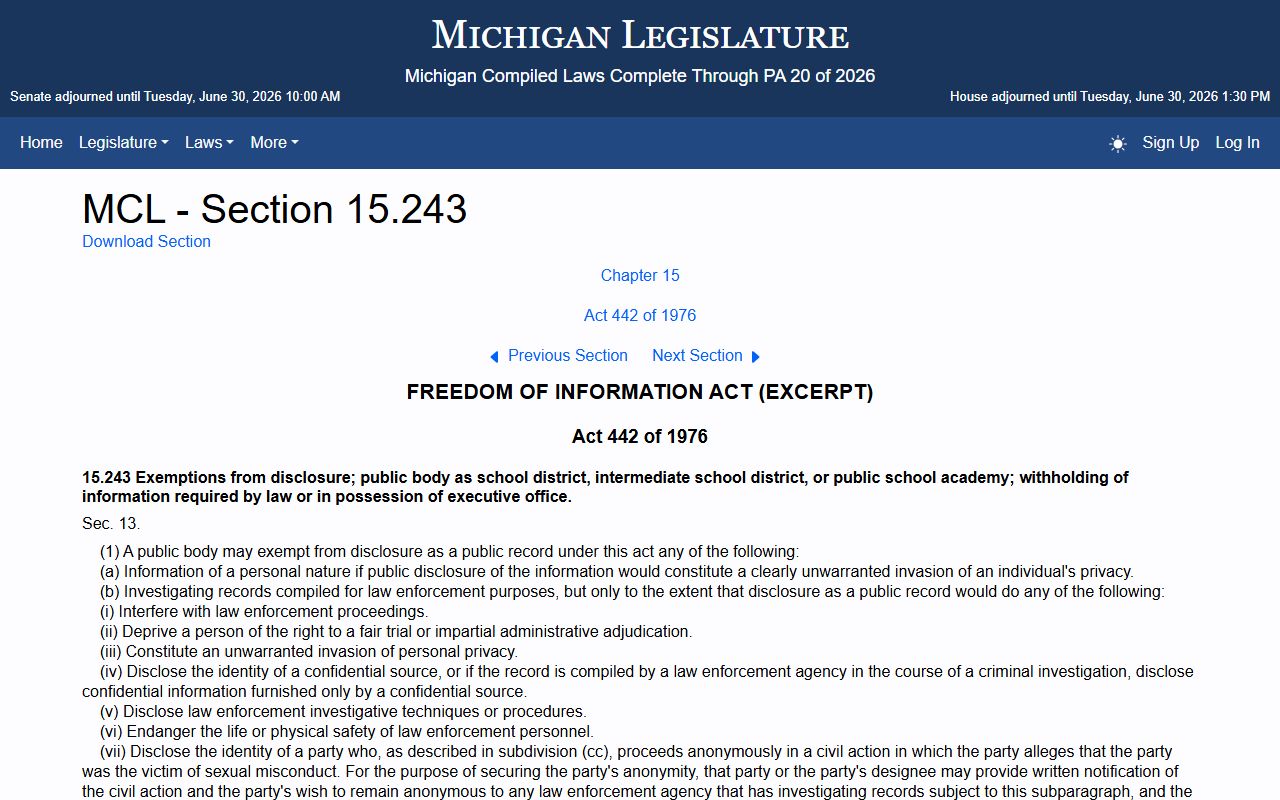
Those carve-outs are written into the statute itself. A closer look at the exemption law explains why some warrant records stay closed.
The exemptions appear in MCL 15.243, which lets a public body deny records such as certain investigating-agency files and personal-privacy material. This statute page anchors the limits that keep some Ionia County warrant records out of public view.
Because of these limits, the surest route is direct contact with the issuing office. The sheriff records desk and Friend of the Court can confirm what a public search will not, and the FOIA process backs them up when a record is held by the county rather than the court.