
Criminal Court Records in Ionia County
A criminal court record is the case file the court keeps once a prosecutor files charges. It is not the arrest report and not the jail booking sheet. It is the running account of the court case itself. The record opens with the charging document. It then grows with each hearing, motion, plea, and order until the judge enters a final disposition and sentence. The Ionia County clerk and the court divisions maintain these criminal case files. For a closer look at the charges alone, see the Ionia County court charge records page, and for the full spread of case types, the Ionia County court records page covers the rest.
Two trial courts produce criminal case records in Ionia County. All criminal cases prosecuted in Ionia County are filed at the 64-A District Court. That court handles misdemeanor cases from arraignment through sentencing. It also handles felony cases from arraignment through the preliminary examination. Once a felony is bound over, it moves to the 8th Circuit Court, which is the county's general-jurisdiction trial court. The 8th Circuit Court hears felonies, serious misdemeanors, and appeals from the lower court. So a single felony can leave a trail in both court files.
How to Search Ionia County Criminal Court Records
Ionia County routes the public to one statewide case search rather than a county-owned database. The MiCOURT public case search covers circuit, district, and probate matters across the state. Because the system is court-specific, a searcher picks the court first. The 8th Circuit path and the 64-A District path each lead to their own records. A terms page loads before any search runs.
- Open the MiCOURT case search and accept the terms gate.
- Choose the right court, either the 64-A District Court for misdemeanors and felony first steps, or the 8th Circuit Court for felonies and appeals.
- Search by the defendant's first and last name, or by the case number if you have it.
- Narrow the results with filters for case type, case year, offense date, or disposition date.
- Open the case to read the docket, then request a certified copy from the clerk if you need one for legal use.
The search layer is powerful once you reach it. The system supports case-status filters, judge lookups, and offense-date and disposition-date ranges. Result expansions can pull charges, participants, the next hearing, and the referee attached to a matter. Starter access does cap the number of returned results, so some users see only part of a large result set.
Stages of a Criminal Case in Ionia County
An Ionia County criminal case moves in a set order, and each step leaves a mark in the file. The record grows as the case advances. Reading the docket in stage order is the fastest way to see where a case stands. In Ionia County the early stages sit in district court, and felony cases shift to circuit court after the preliminary examination.
Case flow: Charges Filed › Arraignment › Pretrial / Motions › Preliminary Exam (felonies) › Plea or Trial › Disposition › Sentencing
| Stage | What Happens |
|---|---|
| Arraignment | The court reads the charges and sets bond. A magistrate can set bail, take a bond, and accept certain pleas at this first stop. |
| Pretrial / Motions | Lawyers file and argue motions, share evidence, and discuss a possible plea. Hearing dates and orders are logged here. |
| Preliminary Exam | For a felony, the district court decides if enough proof exists to send the case to circuit court. This step is unique to felony files. |
| Plea or Trial | The defendant pleads, or a judge or jury hears the case. A verdict or accepted plea sets the outcome. |
| Sentencing | The judge imposes the sentence: jail or prison time, probation, fines, costs, or a mix. The final judgment closes the case file. |
What an Ionia County Criminal Court Record Shows
A criminal court record is more than a name and a number. Each field carries a piece of the case story. The public case view exposes core details, while the full paper file at the Ionia County clerk's counter can hold much more. The table below lists the fields a searcher meets most often when reading an Ionia County criminal case.
| Field | What It Shows |
|---|---|
| Case Number | The court's unique file identifier, tied to the court and the filing year. |
| Defendant | The person charged, listed as a case participant with a name and often a birth year. |
| Charges | Each offense as filed, with the statute cited and the severity level noted. |
| Plea | How the defendant answered the charge: guilty, not guilty, nolo contendere, or no plea entered. |
| Hearings | Scheduled and past court dates, the judge or magistrate, and the courtroom. |
| Disposition | The result for each charge: convicted, dismissed, acquitted, or resolved another way. |
| Sentence | The penalty ordered, including custody, probation, fines, and costs. |
Financial fields also appear on many records. A case can show amounts due and amounts paid on fines and costs. Those figures matter on older cases that still carry a balance. The docket also notes bond posted and any bench warrant issued for a missed date.
Charges vs. Convictions
Being charged is not the same as being convicted. A charge is an accusation. A conviction is a finding of guilt by plea or verdict. An Ionia County criminal court record can show charges that were later dropped, dismissed, reduced, or that ended in an acquittal. Reading the disposition line for each charge is the only reliable way to tell the two apart. The prosecutor files the charge, but only the court records a conviction.
| Charge | Conviction | |
|---|---|---|
| Stage | Accusation at filing | Verdict or accepted plea |
| Who Acts | Prosecuting attorney | Judge or jury |
| Burden of Proof | Probable cause | Beyond a reasonable doubt |
| Can Change | Amended, reduced, or dropped | Set aside only by law |
| Public Record | Yes | Yes |
The prosecuting attorney decides what to charge. Kyle B. Butler serves as the Ionia County prosecutor, with the office on the third floor of the main courthouse at 100 W. Main Street. Charged people who cannot afford a lawyer may qualify for the county public defender, Walter J. Downes, whose office sits nearby on West Main.
Reading Dispositions and Sentences
The disposition is the bottom line of a criminal case. It states how each charge ended. Common entries include guilty, not guilty, dismissed, nolo contendere, and deferred. A deferred disposition holds the case open under conditions, and it may drop off if the terms are met. The date next to the disposition marks when the court closed that part of the case.
The sentence sits just below the disposition. It can list jail time in Ionia County, a prison term served through the state, or a probation period with rules to follow. Fines and court costs appear as dollar figures. When a term reads as a range, the low number is the minimum and the high number is the maximum. Reading both lines together gives the true outcome, since a guilty plea to a lesser charge often pairs with a lighter sentence.
Statewide Criminal History and Prison Records
A single county file does not show a person's whole record. For a statewide criminal history, Michigan runs the Internet Criminal History Access Tool, known as ICHAT. That search pulls felony and serious misdemeanor convictions reported to the state police from courts across Michigan. The Ionia County sheriff's records division points residents to ICHAT for this kind of statewide criminal history check.
State prison status is a separate lookup. The Michigan Department of Corrections OTIS system tracks people held in state prison, on parole, or on state probation. OTIS does not list county jail inmates, so a person held locally will not appear there. To find who is in the county jail, the Ionia County sheriff's jail contacts are the working channel instead.
Sealed vs. Expunged Records
Michigan does not use the word sealed for most criminal files. It uses set-aside. A set-aside, often called expungement, removes a conviction from the public record so the public search no longer shows it. A suppressed case is one the court hides from the public view while the file still exists. The two ideas overlap, but the effect on what the public sees is what matters to a searcher.
| Sealed / Suppressed | Expunged / Set Aside | |
|---|---|---|
| Visibility | Hidden from the public search | Removed from the public record as a conviction |
| Law Enforcement | Limited access remains | Very limited, kept only for narrow legal uses |
| Michigan Basis | Court rule or statute suppression | Set-aside under state law |
| Eligibility | Juvenile, privacy, or ongoing matters | Set by MCL 780.621 and related sections |
Michigan has also moved toward automatic relief. The clean-slate laws let some convictions set aside without an application after a waiting period. The automatic set-aside statute and the clean-slate provisions handle this behind the scenes. When a conviction is set aside, the public case search should stop showing it, though the court keeps a nonpublic copy.
Public Access to Ionia County Criminal Court Records
Ionia County court records sit on their own access track, separate from general county records. Judicial files follow the state court rules, while other public bodies answer to Michigan FOIA. Under the court rules, criminal case files are open to the public unless a rule or statute makes a file confidential, suppressed, or sealed. The public-versus-suppressed status in the case search reflects that split.
Key Statutes:
Michigan FOIA, MCL 15.243 - lists the exemptions that let a public body withhold parts of a record.
Michigan Compiled Laws § 712A.28 - limits public access to juvenile court records.
Michigan Compiled Laws § 780.621 - governs setting aside a conviction so it leaves the public record.
Non-court criminal material can follow a different path. Police reports run through the county FOIA process, and the sheriff's records division handles those requests. A report may stay closed while an investigation or prosecution is still open, so a records request does not always return a file right away.
Federal Criminal Cases for Ionia County
Some crimes are charged in federal court rather than in Ionia County. Ionia County falls within the Western District of Michigan for federal matters. A federal case never appears in MiCOURT or the county clerk's files, so a searcher has to switch systems once the matter turns federal. The court's public site explains the district's reach and its courthouse locations.
The U.S. District Court for the Western District of Michigan home page is the starting point for federal criminal case information in this region.
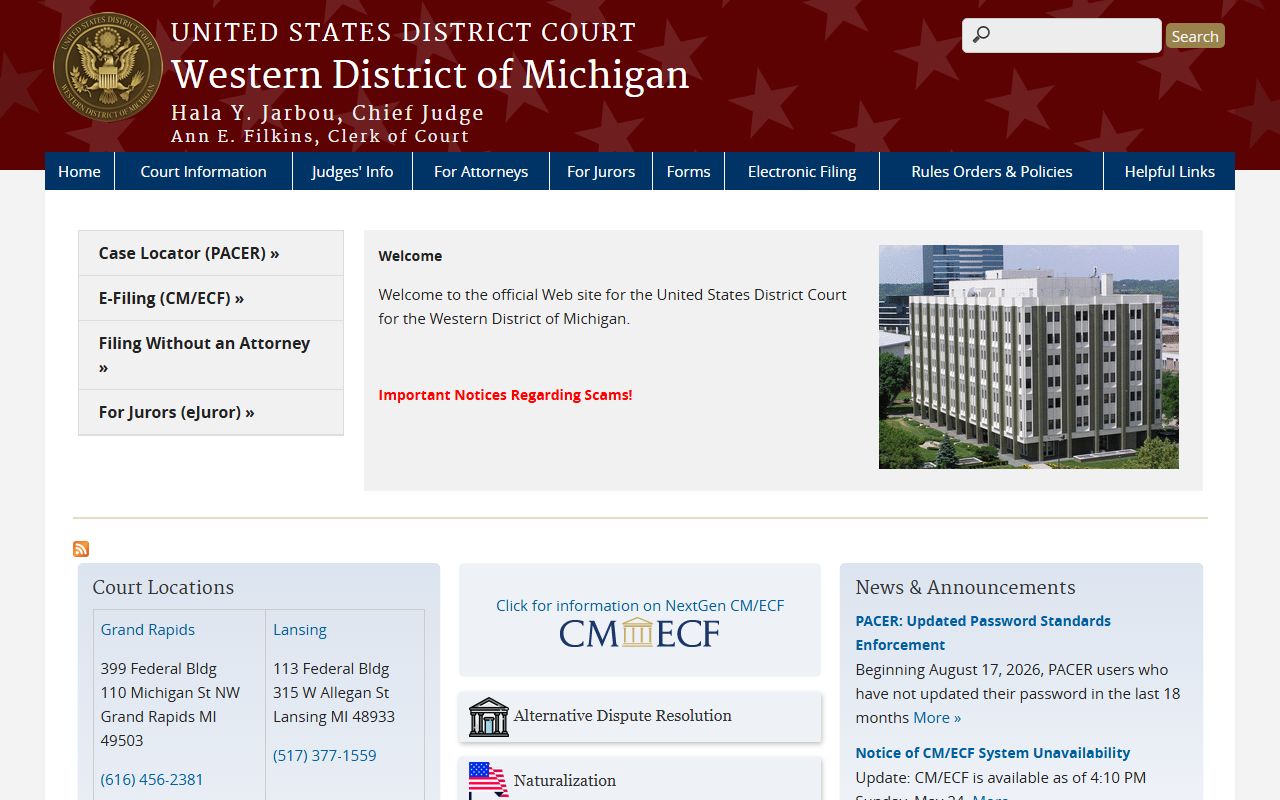
That court handles federal prosecutions that reach residents of the county, which the county sheriff and county clerk do not process. To read the actual docket in a federal case, the public uses the electronic filing system.
The Western District CM/ECF portal connects to PACER, the account-based system that serves federal dockets and filings.
PACER is the federal parallel to the state case search, though it charges for access rather than running as a free county page. When a searcher needs help reaching the clerk or confirming a filing method, the court publishes its contact details online.
The Western District contact page lists the clerk's office phone numbers and courthouse addresses for the district.
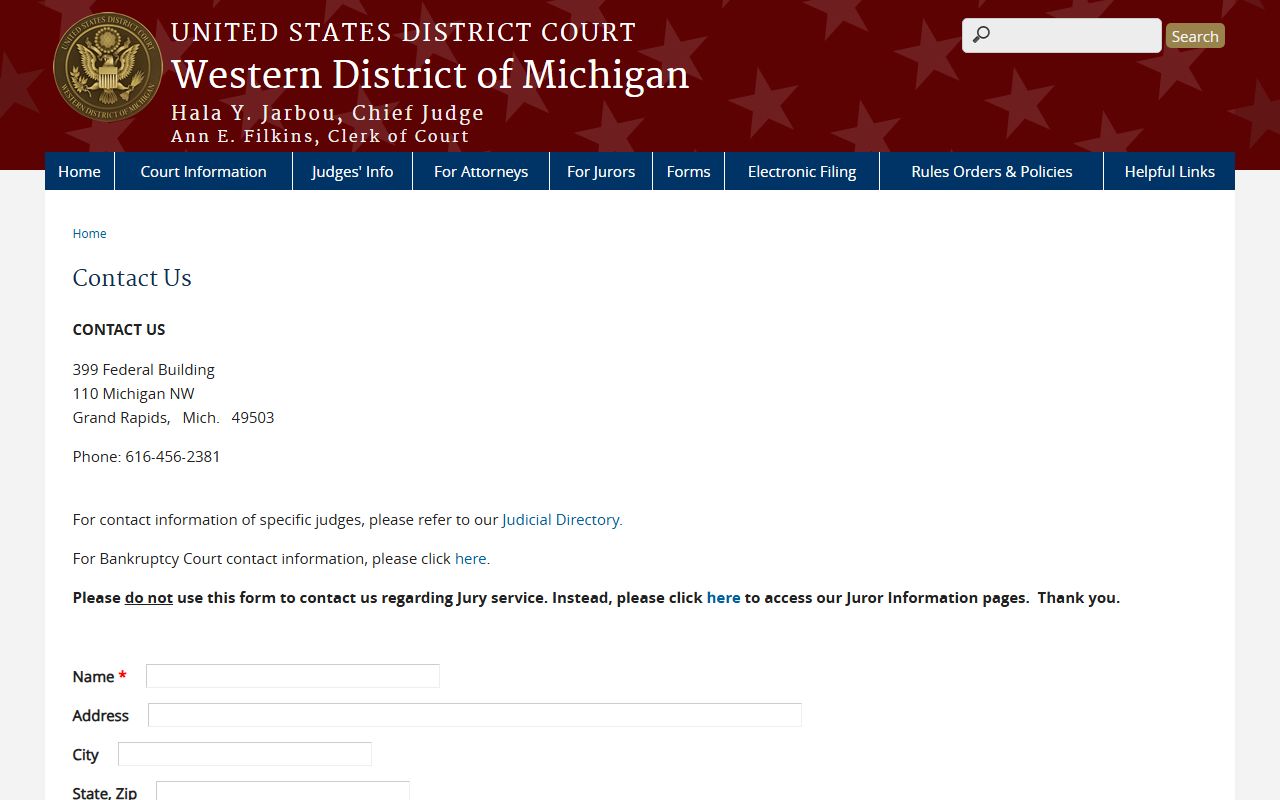
Those contacts help when a case number or filing is hard to find online. Federal charges themselves are brought by the United States Attorney, not the county prosecutor.
Background Checks and Ionia County Criminal Records
A casual case lookup is not the same as a formal background check. Reading a criminal court record for personal knowledge is fine. Using it to decide on a job, a rental, credit, or insurance falls under the federal Fair Credit Reporting Act, which sets strict rules. Anyone using Ionia County criminal records to screen applicants must use a compliant process, and the federal prosecutor's office explains how criminal cases are pursued in the district.
The U.S. Attorney for the Western District of Michigan handles federal prosecutions that can affect county residents.
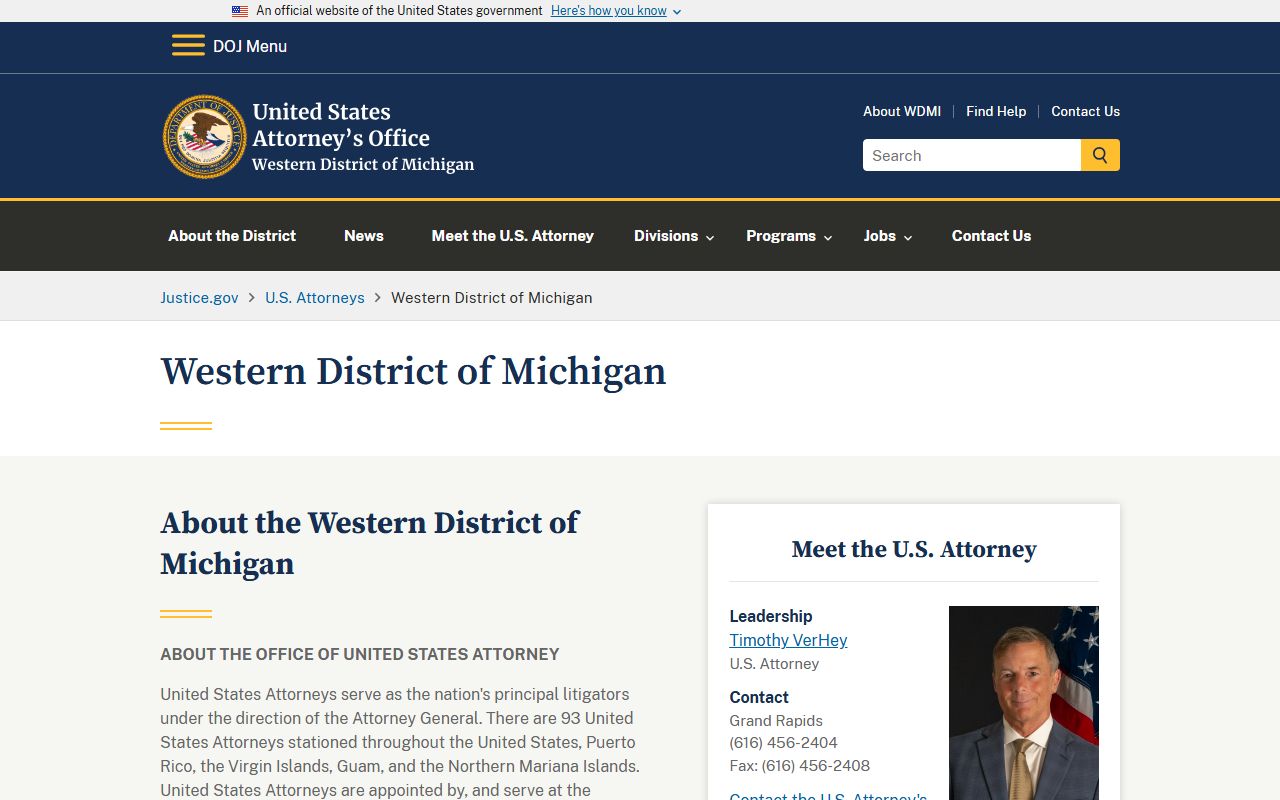
For a certified, court-reviewed history, ICHAT and the clerk's certified copies are the reliable sources. A quick online result should be verified against the official file before anyone relies on it.
Important: This site is not a consumer reporting agency under the FCRA, and its records may not be used for employment, tenant, credit, or insurance screening.
Restricted Criminal Court Records in Ionia County
Not every Ionia County criminal matter shows in the public search. Juvenile cases are handled in the circuit court's family division, and state law limits who can view those files. Cases marked suppressed stay out of the public view even when an index exists. A file may also be quiet because a proceeding is still open, or because a set-aside has removed a conviction from public access.
When a record is missing from the search, the honest read is that it is unavailable to the public, not that it never existed. Sealed, suppressed, juvenile, and expunged files all sit behind that wall. If an active matter includes a bench warrant, that warrant can surface in the same docket. For anything the public search will not return, the county clerk's counter and the court divisions are the next stop, and a certified copy request is the surest route to an official record.
Note: A record hidden from the public search may still exist in a nonpublic court file, so absence from an online result is not proof of a clean history.